Wunmi Semudara
A Non-Governmental Organisation, Gender Strategy Advancement International (GSAI) has registered their displeasure at the exclusion of women, and persons with disabilities in governance.
They also charged Journalists to hold government and other stakeholders accountable on issues of gender inclusivity especially for Persons With Disabilities.
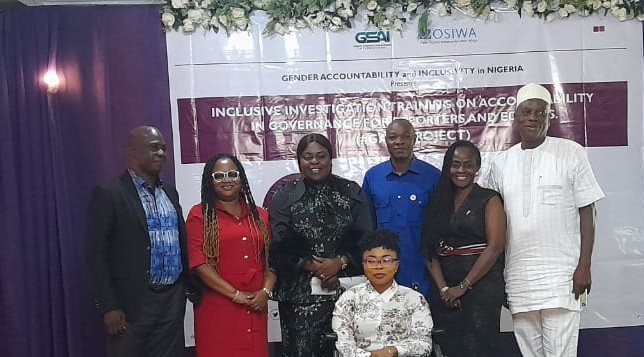
The Executive Director, Gender Strategy Advancement International, (GSAI), Adaora Sydney-Jack, made this call at a one-day Inclusive Investigation Training on Accountability in Governance for Reporters and Editors in Abuja.
The event was organised by Gender Accountability and Inclusivity in Nigeria, (GAIN), in partnership with GSAI and the Open Society Initiative for West Africa, (OSIWA), in Abuja.
The Executive Director of GSAI stressed the importance of promoting equal rights and opportunities to change narratives and cultivate a culture that values and celebrates inclusion.
“We have been at the forefront of advocacy for increased women’s participation in governance, gender-friendly policies, and amplifying women’s voices in the civic space.”
“GSAI’s mission is centred on five pillars; gender advocacy, accountability, gender justice, gender-driven research, and partnership, aiming to position women’s rights as a national priority through the powerful tool of media.”
“We gather here for a crucial purpose that involves the inclusive training of 40 reporters and editors from across the country across various media platforms: TV, radio, print, and online.”
“The core objectives of this training include increasing reportage and editorials on the performance and shortcomings of the government from a gender accountability perspective, empowering media professionals to independently promote and advance women’s rights, gender accountability, and hold the government accountable for its actions,” she said.
Adaora added that the training is to encourage and support story projects and reports that shed light on the lapses in the performance of public office holders, as well as the political and economic performance of Nigeria.
The Chairman of the National Union of Journalists, Osaretin Osadebamwen, who was represented by his deputy, Timothy Choji, also tasked the media to call the government’s attention to policies concerning women and PWDs.
” Journalists have the sacred task of highlighting women’s issues and issues of gender inclusivity even when being often perceived as anti-government”, he said.
“The training sessions are skewed to open your eyes and storytelling mind to see the lapses in genuinely designed policies and programmes of government national or subnational that would need to be tweaked for good”, he said.
A Gender advocate and media personality,
Dr Inya Ode urged the media to adhere to the ethics of the profession when reporting gender-related matters.
She called on the media to utilize its platforms to sensitise the public on eliminating stereotypes against Persons with Disabilities (PWDs).
“Our stories should engender positive change in the society and as gatekeepers in the field, we should readily inform and cause positive transformation.”