By Bukola Afeni
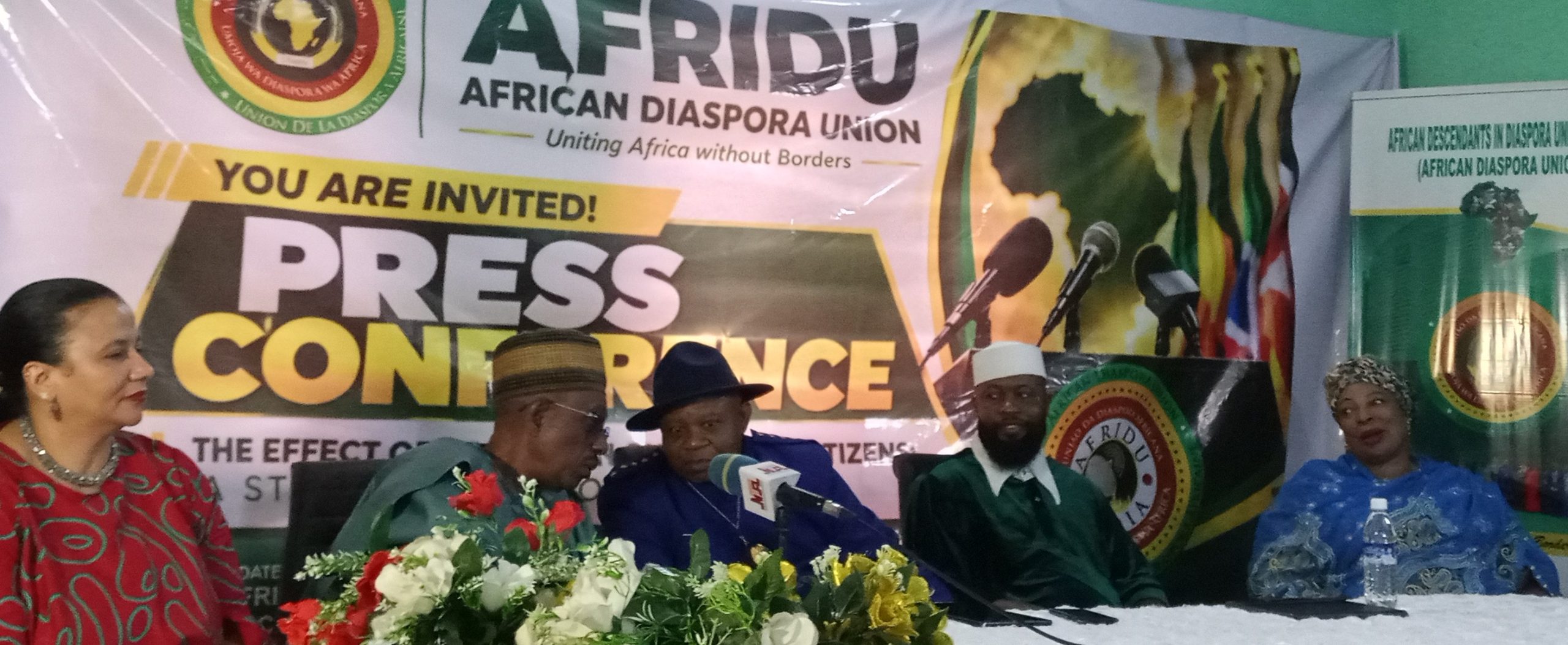
The Global President of the African Diaspora Union, Africa, AFRIDU, Professor Archbishop Chidiebere Aralachi Ogbu, has called on African leaders to move beyond enforcement of laws and address the root causes that make Africans vulnerable to trafficking and dangerous migration.
Prof. Ogbu made the call in Abuja at a press conference in preparation for the forthcoming High-Level Strategic Dialogue on Migration in Africa.
He said responsible leaders must have the courage to ask uncomfortable questions about migration and provide sustainable solutions to stop what he described as suicidal attempts by Africans crossing the Mediterranean Sea and deserts.
“There are uncomfortable questions that responsible leaders must have the courage to ask, and asking is not enough, neither is enforcement of laws enough, but we must attack the root causes that make people vulnerable to trafficking,” he said.
“We must discuss why people take the risk of crossing the Mediterranean Sea on ordinary boats to reach the shores of Europe and understand the solutions African leaders can offer to stop these suicidal attempts,” he added.
The AFRIDU President also raised concerns over xenophobic attacks and targeted violence against African migrants in other African countries.
According to him, there is a need to discuss why particular African migrants become targets because of their nationality or perceived foreign status, and who protects victims when such attacks occur.
“We must discuss when an African is attacked in another African country, who protects the African victim, or do we simply record the incident and move on? When African businesses are destroyed, when people are intimidated, when nationality checks are conducted by unauthorized people, when foreign nationals are attacked or killed, who is to be held accountable?” he queried.
Prof. Ogbu stressed that Afrophobia and attacks against African migrants should not be treated as purely domestic matters.
He proposed that the African Union should establish a continental monitoring and accountability mechanism to track serious incidents, government responses, prosecutions, and progress across member states.
“We cannot continue to look at this phenomenon as a mere matter of immigration statistics,” he noted.
The AFRIDU President explained that the African Diaspora Union, Africa, registered in Nigeria as African Descendants in Diaspora Union, is a Pan-African organization committed to promoting African unity, diaspora engagement, sustainable development, youth empowerment, peace building, investment diplomacy and advancement of the rights of African peoples and descendants.
Speaking on preparations for the dialogue, the AFRIDU Global President disclosed that all relevant ministries and agencies connected to migration were officially invited for collaboration.
“Immigration, NAPTIP, name it, every important ministry that has one connection or the other with travelling, they were all officially invited and requested for collaboration to make sure this happens. There are some that responded positively,” he said.
In the same vein, he disclosed that the organization has also extended invitations to African ambassadors in Nigeria through the Ministry of Foreign Affairs.
“The deliberative committee worked very hard and did its best through the Ministry of Foreign Affairs to invite African ambassadors that are in Nigeria. We extended invitation letters and held meetings with the Chief Protocol Officer. We did the best we can to invite them because we believe that it is a discussion for Africans,” he stated.
Prof. Ogbu further expressed appreciation to state governors, corporate organizations, and Nigerian community groups in South Africa who supported stranded Nigerians during difficult periods.
“We appreciate state governors and corporate organizations who showed care and supported stranded Nigerians and also congratulate the Nigerian Citizens Association South Africa, Nigerian Union South Africa, NUSA, and all other Nigerian organizations who came in mass to support stranded Nigerians in South Africa during the horrifying times,” he said.
He said the dialogue will continue to engage the leadership of the Federal Republic of Nigeria and its missions in South Africa to ensure protection and dignity for Africans across the continent.
The Special Envoy of the African Diaspora Union, Africa, AFRIDU, to the Federal Republic of Nigeria and Chairman of AFRIDU Nigeria Governing Council, Professor Abduljalil Tafawa Balewa attributed the rising youth migration, human trafficking and xenophobic attacks to the absence of a comprehensive national development plan by successive governments.
He said the essence of the gathering was not just to dialogue, but to bring out policies that will address the challenges of irregular migration and protect African migrants.
“The main reason why we have to gather is not just merely to dialogue but to bring out policies that are very important. Our people are crossing with boats, crossing the sea to Cameroon, to Gabon, to Europe, and everyday many die. We have lost thousands and thousands of Nigerians trying to cross the sea,” he said.
The AFRIDU envoy noted that while there have been improvements at the legislative level, more needs to be done on the executive and diplomatic fronts to tackle Afrophobia and related attacks against Africans in other African countries.
He explained that the organization invited critical stakeholders and government agencies to be part of the conference to discuss important national issues, adding that the forum remains apolitical.
“When we were sending out invitations, we had at the back of our mind that we are apolitical. It is not about APC, PDP, ADC. It is about Nigerians and Africans coming together so that something has to be done,” he said.
Prof. Balewa said he was impressed with recent improvements observed in the country upon his arrival, expressing optimism that Nigeria is on the path to recovery despite past challenges.
“I just arrived from the international airport and some of us who have not come into Nigeria for some time saw the improvements. Nobody can tell you that the country is not working. The truth of the matter is the country is working. It got worse, but gradually it will improve. We see a new Nigeria, something is cooking, it is happening but it takes time,” he stated.
Prof. Balewa disclosed that there were measures to keep young Nigerians gainfully employed within Africa.
He traced the problem to lack of proper planning by successive administrations.
“Except for the First Republic, most governments did not have any development plan or work with any development plan. We have not had census in a while. We don’t even know how many people in Nigeria have been to primary school, secondary school or university. They don’t have any future plans on employment. That is why our governments have not worked for the people,” he said.
He noted that Nigeria is now in its 27th year of continuous democratic governance, which he described as a positive development despite some setbacks. He recalled the progress recorded before 2015, including the peaceful handover of power by former President Goodluck Jonathan to an opposition party, which he described as unprecedented in Africa.
Prof. Balewa lamented that many young Nigerians in search of better opportunities end up in prostitution, die in the desert or drown in the sea, while other African countries Nigeria once looked down on are now hosting Nigerians.
He called for a blend of local and diaspora expertise to drive employment creation and national development, stressing that leaders who have never studied or worked abroad may not fully understand the plight of Nigerians in the diaspora.
“Our governments up until now did not really have a plan for the people. That is why we are advocating for a mix, for our people abroad who are doing well to come and help the government on the issue of employment or bring their experiences back,” he said.
He added that the contributions of Nigerians in the diaspora remain critical to national development and called for stronger protection for Nigerians facing xenophobic attacks in countries like South Africa and Indonesia.
“It is a terrible thing when you hear of Nigerians being killed in xenophobic attacks in South Africa. We need to discuss what our country should do and how we should protect our people,” Prof. Balewa added.


