Bukola Afeni
The Program Manager of Civil Society Scaling Up Nutrition in Nigeria, CS-SUNN, Ridwan Awosanya, has called for urgent action to translate nutrition policies into measurable results at facility and community levels.
He made the disclosure at the bi-annual press briefing on the anaemia situation in Nigeria organised by CS-SUNN.
Speaking on findings from a recent study, Awosanya said Nigeria has made progress with key policy and institutional foundations, including the inclusion of Multiple Micronutrient Supplements, MMS, in the Essential Medicines List and the establishment of the Child Nutrition Fund, CNF, as a domestic financing mechanism.
However, he noted that weak implementation is undermining impact.
Awosanya said while policy pronouncements and institutional arrangements are in place, results will only come with deliberate implementation.
“Specifically, we must close the gap between policy commitment and measurable results at the facility and community level. The evidence is available, recommendations are clear. What is required now is political will and collective commitment to implement them,” he said.
The CS-SUNN Program Manager further urged CSOs, the federal and state governments, partners, research institutions, communities, and the media to work constructively to advance the nutrition agenda.
“We must strengthen local manufacturing capacity, ensure predictable funding, and invest in systems that deliver MMS and quality antenatal care to every woman, especially in underserved communities,” he concluded.
In the same vein, he added that key findings from the study show that antenatal contact remains low.
“Achieving the recommended 8 to 10 antenatal contacts is critical because fewer visits mean fewer opportunities for repeated counselling, screening, follow-up, and support for adherence.”
He further stated that the study shows MMS is acceptable to women.
“Where available, 62.9% of women received MMS during pregnancy. 33% reported daily use, and 92.1% expressed willingness to take MMS again if available.
“This clearly shows that women are willing and that uptake can increase quickly if the system is regular,” Awosanya said.
Yet only 39.4% of health workers reported that MMS was always in stock in their facilities. 18.3% said their facilities were frequently out of stock, and 24.7% reported that restocking takes more than two months after a stock-out,” he added.

The National Coordinator for Academic and Research, Scaling Up Nutrition in Nigeria, Prof. Kola Anigo, also called for deliberate and coordinated action to improve Nigeria’s health system, warning that repeating the same approaches will not yield different results.
He highlighted the need for a standardized approach to nutrition and maternal health.
Anigo said supervision and monitoring at health facilities remain critical to ensuring health workers follow laid-down protocols.
The nutrition expert stressed that interventions such as Multiple Micronutrient Supplementation, MMS, for pregnant women will only succeed if demand is created at the community level and commodities are readily available.
“Anything that you do now in Nigeria that does not translate to a change at the community and the household level, we are wasting our time because that is where the people are,” he said.
Anigo noted that while political commitment is evident in budgetary allocations, financing is still not predictable.
He explained that commitment must translate to allocation, release of funds, and ultimately to services at the facility level.
Citing data from 21 states, Professor Anigo said 62% of states recorded no Counterpart Funding for CNF in 2024 despite policy provisions.
He added that 38% reported no allocation in 2024, while 33% had none in 2021.
“We are urging government to ensure released funds are converted into actual commodities and services,” he said.
The expert also raised concerns over accountability, stating that clashes among departments, ministries, and agencies are often driven by control of funds rather than desire for results.
On scaling interventions, Anigo said MMS must become a routine part of Antenatal Care, ANC, and be integrated into the supply chain.
He called for quality ANC contacts that include screening for anaemia, counselling, and support for adherence.
He further emphasized the need to carry underserved communities along, noting that failure to involve communities has caused many health programs in Nigeria to fail.
Anigo commended stakeholders, especially the media, for their commitment, and said the research provides evidence to inform sustainable and scalable solutions.
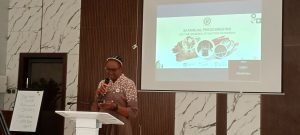
The FCT Chapter President of the Nutrition Society of Nigeria, Major Nwachinemere, also called for renewed national commitment to reduce malnutrition, stressing that urgent collaboration across all levels of government and stakeholders is needed to save lives.
According to her, Nigeria cannot afford to downplay the burden of malnutrition.
“Government, local partners, state government, civil society, and the private sector must come together to strengthen nutrition action and accelerate the reduction of malnutrition in Nigeria.”
Major Nwachinemere urged that nutrition briefings and data presentations go beyond statistics to drive real change.
“Let this briefing be more than an opportunity to present statistics. Let it be a renewed national commitment to ensuring that every Nigerian child, adolescent, woman, and family has the opportunity to live a healthy and productive life,” she stated.
The FCT President commended Civil Society Organizations for taking the lead in advocacy and called for stronger partnerships to translate research into practice.
“On behalf of the Nutrition Society of Nigeria, I commend CSOs for this kind of initiative and wish you successful outcomes,” she said.
The FCT President further charged stakeholders to move from evidence to implementation.
“So together, let us transform evidence to action, commitment to implementation, and implementation into measurable improvements in our nutrition indices in Nigeria,” she added.