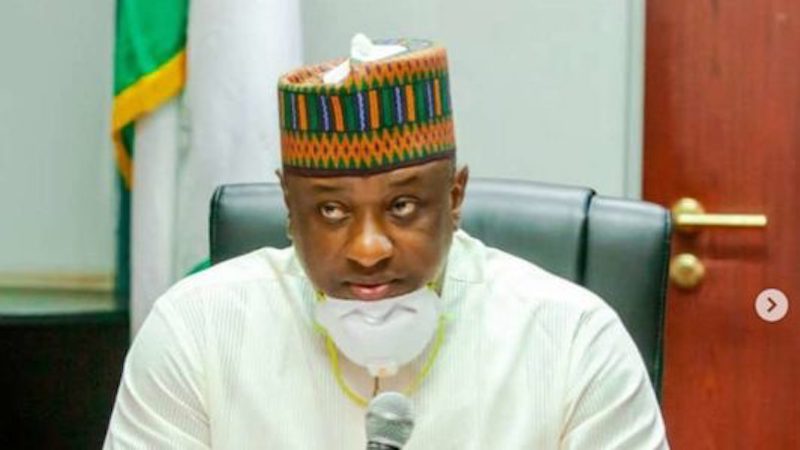
Bukola Afeni
The Honourable Minister of Budget and Economic Planning, Senator Abubakar Atiku , has raised alarm over the economic burden of malnutrition in Nigeria, estimating an annual loss of $56 billion, equivalent to 12.2% of the country’s Gross National Income (GNI).
He made the disclosure at the High-Level Dialogue on the Cost of Inaction on Malnutrition in Nigeria in Abuja
Bagudu emphasized the urgent need for sustainable financing and multi-sectoral approaches to tackling the crisis.
“Financing remains among the best options to leverage and drive our multisectoral approaches to improving nutrition and food security.
“This will entail an increased commitment from public and private sources, reducing reliance on development partners and donors to implement programmes and initiatives that address the root causes of malnutrition,” he said.
He highlighted the worrying findings of the 2023 Nigeria Demographic and Health Survey (NDHS), which revealed that 40% of Nigerian children under five suffer from stunting, reversing previous gains in nutrition.
The Minister reiterated the Federal Government’s commitment to combating malnutrition through strategic policies, increased investment in nutrition programs, and grassroots interventions under the Nutrition N774 Initiative.
The Chairman of the House of Representatives Committee on Nutrition and Food Security, Hon. Chike Okafor, called for urgent action to address malnutrition and food insecurity in Nigeria, warning of its socio-economic and security implications.
He highlighted legislative efforts, including extending maternity leave to six months and abolishing multiple taxation on food transportation, while calling for increased funding and grassroots intervention to combat hunger nationwide.
Okafor emphasized that tackling malnutrition and food insecurity should not be confined to discussions in Abuja.
He stressed the need to extend the conversation to states, local governments, wards, and communities, where the issues are most severe.
“Our results must match our rhetorics and actions. We must chart a new course. We must ensure that we not only have more money for nutrition, but also more nutrition for the money. The man in the remote village is burdened with malnutrition and food insecurity much more than the man in Abuja.
‘Because he is hungry, he cannot sleep. Because he cannot sleep, the big man in Abuja and the other major towns and cities cannot sleep as well. Malnutrition breeds insecurity and social unrest. Let us do more to stop this vicious cycle.”
Okafor stated that the Legislature is committed to playing its part in tackling these twin challenges, in alignment with President Bola Ahmed Tinubu’s Renewed Hope Agenda.
The Country Director of Nutrition International Dr Osita Okonkwo said the nutrition body has collaborated with Nigerian government to improve the health and nutrition of children, adolescent girls and women across the country.
” Together, we have reached 9.4M children under five with two doses of Vitamin A, which can help prevent up to 12 percent fewer deaths.
“We have also distributed 26.4 M doses of iron and folic acid tablets to pregnant women in public health facilities, supporting maternal health at an essential moment for both mother and child.
Dr Osita further noted that Nutrition International have also equipped nearly 800,000 caregivers of children under five with vital knowledge about prevention and management of diarrhea in young children.
He further introduced the “the Innovative Cost of Inaction Tool ” which generates estimates on the health , human capital and economic costs of Inaction.