Bukola Afeni
The Merck Foundation has reaffirmed its commitment towards sustainable development through healthcare capacity building and education in Africa and Asia.
The Merck Foundation, in collaboration with First Ladies from Africa and Asia, also announced an expansion of its health and education initiatives, awarding over 2,270 scholarships to doctors from 52 countries across 44 critical medical specialities.
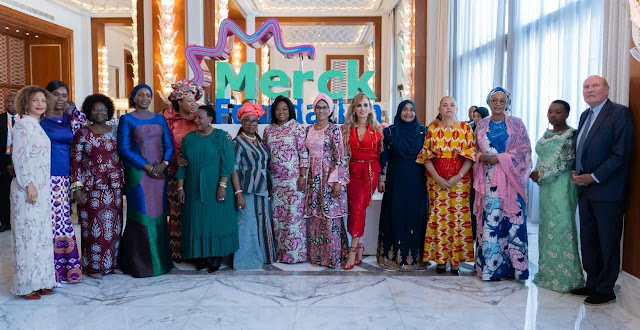
The announcement was made during the 7th edition of the Merck Foundation First Ladies Initiative (MFFLI) Summit, held in partnership with several African First Ladies, including Nigeria’s First Lady, Senator Oluremi Tinubu, in Dubai.
Speaking at the high-level event, the CEO of the Merck Foundation, Senator Dr. Rasha Kelej, described the scholarships as a major step in reshaping healthcare delivery across underserved nations.
“We provided almost 1,000 scholarships for girls until they finish their school education, and more than 17 countries, in partnership with the First Lady, 1,000 girls in 17 countries,” Dr. Kelej stated.
In her remarks, Nigeria’s First Lady, Senator Oluremi Tinubu, confirmed that 63 Nigerian doctors have benefited from the Merck Foundation’s scholarships.
These include programs in fertility, embryology, reproductive care, oncology, diabetes, cardiovascular medicine, and psychiatric care.
“I am committed to expanding it further through my office and the Federal Ministry of Health and Social Welfare. By doing so, we will be able to empower more Nigerian doctors, ultimately enhancing public healthcare and improving the well-being of our people,” Senator Tinubu said.
The First Lady also highlighted recent collaborations in media training.
“On May 8, 2025, 21 media representatives from the Nigerian Union of Journalists participated in an online community awareness media training program facilitated by Merck Foundation in collaboration with my office, to equip them with the necessary skills and knowledge to effectively report critical health issues, particularly in the areas of reproductive, maternal, and child healthcare.”
She added that beyond healthcare, the Merck Foundation is advancing gender equality through its Educating Linda program, which supports 1,000 underprivileged girls with scholarships in 17 countries.
“The efforts aim to combat early marriage, teenage pregnancy, and school dropout by helping girls complete their education. As a lifelong teacher, I believe education is the most powerful tool to transform society,” said Senator Tinubu.
She noted that through her Renewed Hope Initiative, over 5,100 bursaries have been awarded to female students in Nigeria, with 40 alternative schools established to support girls who dropped out due to early pregnancy or marriage.
In his keynote address, Professor Dr. Frank Stangenberg-Haverkamp, Chairman of the Merck Foundation Board of Trustees, emphasized the urgent need for trained healthcare workers across Africa. “According to the WHO report of 2021, Africa has 24% of the global disease burden, whereas there are only 2.91 healthcare workers per 1,000 capita. This is compounded by the maldistribution of the workforce among urban and rural areas and the public and private sectors,” he said.
Dr. Haverkamp noted that many countries, such as The Gambia, Liberia, Burundi, and Sierra Leone, had no specialists in oncology, fertility, or respiratory care before Merck Foundation’s intervention.
“I am very pleased to say that since 2012, the foundation, together with partners, has significantly strengthened healthcare capacity by providing over 2,270 scholarships of one-year and two-year master’s degrees to further qualified doctors from 52 countries across 44 critical and underserved medical specialities,” he said.
The Foundation also promotes health awareness through its Community Awareness Programs, including children’s storybooks, animation films, music, and media awards.
“The initiatives address social issues such as gender-based violence, infertility stigma, female genital mutilation, and child marriage.”
The summit, live-streamed to more than 8 million viewers worldwide, also featured sessions attended by over 6,000 online participants.