Esther Salifu
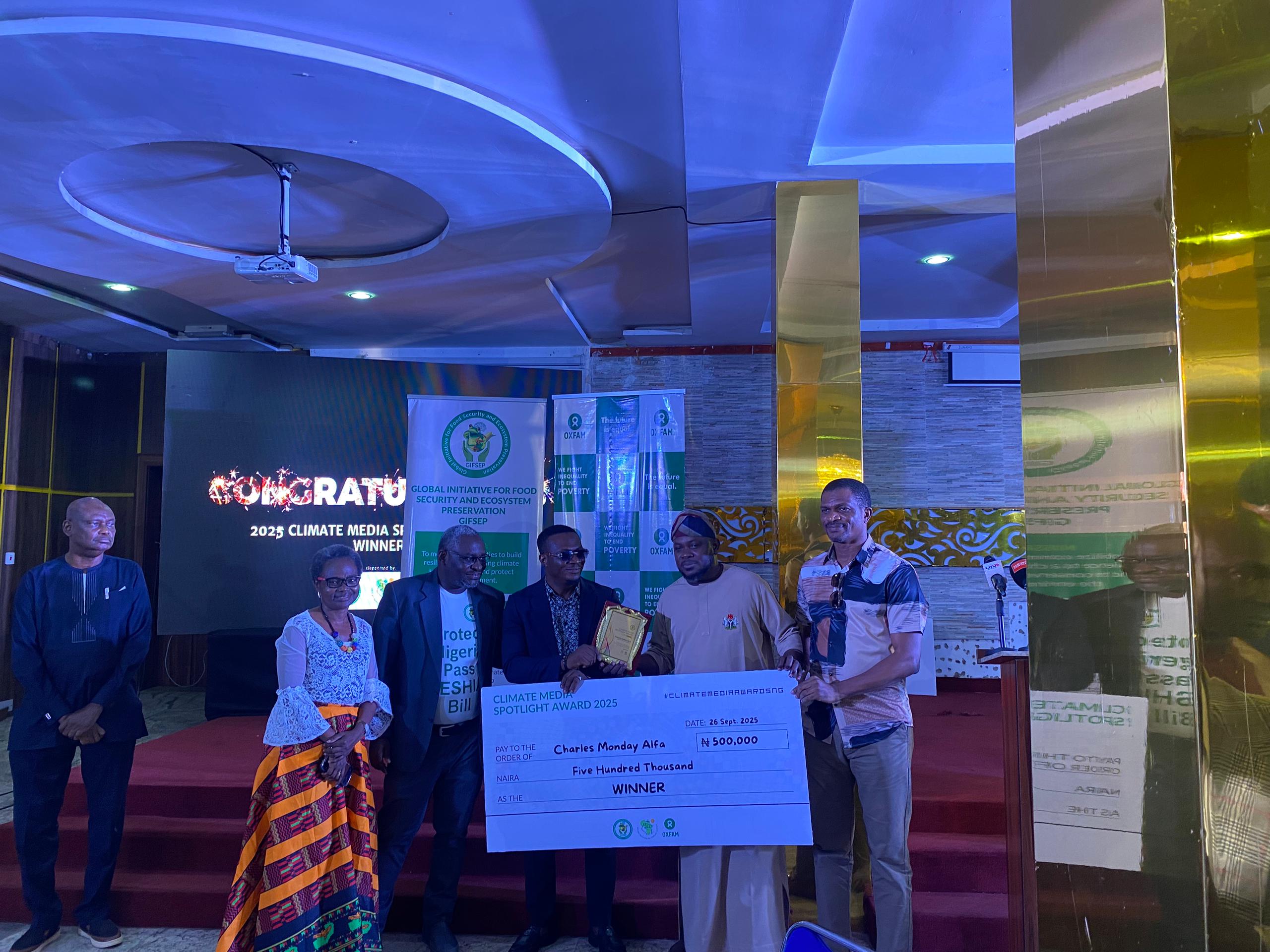
The Nigeria Television Authority (NTA), journalist Charles Monday Alfa has emerged the winner of the 2025 Climate Justice Media Award for his outstanding reporting on climate justice and environmental issues.
The award ceremony, jointly organized by the Global Initiative for Food Security and Ecosystem Preservation (GIFSIEP), Oxfam, and the African Activists for Climate Justice (AACJ), was held in Abuja.
Alfa received a ₦500,000 cash prize and a commemorative plaque in recognition of his impactful contributions to climate-focused journalism in Nigeria.
Michael Simire, Editor-in-Chief of EnviroNews, emerged as the First Runner-Up, receiving ₦350,000 and a plaque, while Abdulkareem Mojeed of Premium Times took the Second Runner-Up spot, with ₦250,000 and a plaque.
Before unveiling the top three winners, organisers announced 10 finalists, including Nkoli Omhodu (AIT), Anthony Momodu (Arise TV News), Amechi Oyema (The Authority Newspaper), Patrick Oluwaseun (Channels Television), Abigail Joshua (NAN), and Joy Onyekwere (Peoples FM).
Each nominee received ₦100,000 and a certificate of recognition.
Speaking at the event, Executive Director of GIFSIEP, Michael David, emphasized the importance of climate storytelling.
“This award is about more than just recognition. It’s about amplifying the stories of how climate change affects people and communities, and how solutions like renewable energy and adaptation strategies are taking shape,” he said.
He urged continued investment in environmental journalism despite funding challenges, stressing that the climate crisis demands “informed voices now more than ever.”
Also addressing the gathering, Special Assistant to the President on Climate Change Matters, Yusuf Olatunji Kelani called for reforms in climate education.
He noted that in Nigeria, climate change studies remain confined to the pure sciences, unlike in other countries where it is offered under the social sciences to widen access.
Kelani also identified poor planning and disregard for environmental laws as causes of Nigeria’s recurrent flooding.
“A lot of the flooding we are having in Nigeria is man-made. We flout the rules, we build on flawed plans, and the consequences are devastating,” he warned.
Pioneer National Coordinator of the GEF-Small Grants Programme in Nigeria, Olabamise Idironke highlighted the shift in environmental priorities.
“Sixteen, seventeen years ago, biodiversity was the focus. Today, climate change has overtaken everything,” she said, urging Nigerians to embrace personal responsibility in addressing environmental issues.
Country Director of Oxfam, John Makina, stressed the media’s role in governance, particularly in combating misinformation and holding policymakers accountable.
“It is unfortunate that, in this century, some people still deny climate change. The media must ask the difficult questions and ensure the public is well-informed,” he said.
While stressing the need to combat misinformation, Makina urged journalists to hold policymakers accountable at all levels.
“I want to urge the media houses so that we are able to ask the difficult questions about climate change to different stakeholders, particularly the policymakers.”


