Bukola Afeni
As part of ongoing efforts to strengthen evidence-based nutrition policy and programming in the country, stakeholders and health experts have validated two landmark studies conducted by the Academic and Research Network of the SUN Movement in Nigeria.
The workshop, held in Nasarawa State, was organized in collaboration with CS-SUNN and supported by UNICEF.
The validated studies “The Costing Analysis of Nutrition-Specific Interventions” and “The Assessment of Maternity Protection Practices in Public and Private Organizations” were presented at a high-level validation workshop aimed at enhancing the use of research and data in national nutrition decision-making.

Speaking at the event, Prof. Kola Matthew Anigo, National Coordinator of the Academic and Research Network, Scaling Up Nutrition Nigeria (ARN-SUNN), emphasized the importance of grounding nutrition policies in robust, context-specific evidence.
“This workshop marks a key moment in our collective efforts to deepen the use of evidence in nutrition policy and programming in Nigeria.
“The project reflects a growing recognition that effective nutrition decision must be backed by strong data. It also highlight the vital role academia must play in generating and translating evidence into action.”
Prof. Anigo lauded the leadership of Nigeria’s SUN Focal Points for creating a collaborative, multi-stakeholder environment that made the work possible. He also extended deep appreciation to UNICEF for its critical technical and financial support.
“UNICEF not only supported the research but also enabled a knowledge translation workshop that built the capacity of our academic network members. This was not just timely, it was necessary.”
The workshop also spotlighted the contributions of the Civil Society Scaling Up Nutrition in Nigeria (CS-SUNN) platform, through which the Academic and Research Network was convened.
According to Prof. Anigo, the partnership exemplifies how civil society and academia can complement government efforts in tackling malnutrition.
As the event moved toward validating the research findings, Prof. Anigo expressed confidence that the process would go beyond endorsing reports.
“We believe this will also strengthen the pathway for deeper academic-policy linkages in nutrition.
“Now, the challenge is to institutionalize these relationships, ensuring academia becomes a permanent and proactive partner in national nutrition decision-making.”
He further called on participants to collaborate in transforming research into actionable policy for a healthier, well-nourished Nigeria.
Also speaking at the event, Ridwan Adesanya, Programme Manager for Civil Society Scaling Up Nutrition in Nigeria( CS-SUÑN), emphasized the urgent need for a well-costed plan to guide resource mobilization.
“It’s critical we have this costing so that we have a clear understanding of the kind of resources needed to tackle malnutrition in Nigeria,” he stated.
Adesanya described malnutrition as a persistent and deeply concerning issue in Nigeria, with the prevalence of stunting hovering between 37% and 40% for over three decades.
“The indicator has shifted by only plus or minus 3% since 1990. That is quite an embarrassing situation,” he said.
Nigeria currently bears the highest burden of malnutrition in Africa and ranks second .
He highlighted that a costed roadmap is essential for coordinating national and donor resources, guiding policy, and making measurable progress in reducing malnutrition.
“This validation is not just about figures, it’s about creating a plan that works, that is fundable, and that can drive real change,” he concluded.
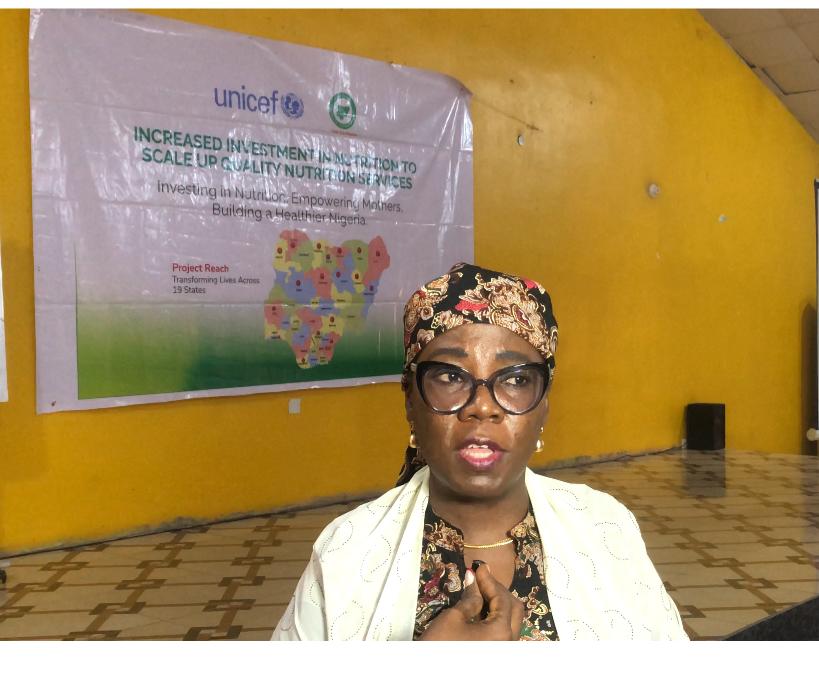
Dr. Ladi Bako Aiyegbusi, Director of the Nutrition Department at the Federal Ministry of Health and Social Welfare, also underscored the significance of the two studies.
“The findings are meant to guide the ongoing transformation agenda of the Coordinating Minister for Health and Social Welfare, especially in crushing Nigeria’s persistently high malnutrition rates,” she said.
The Director noted that while effort to improve the quality of nutrition services have often focused on public health facilities, gaps in training especially in private sector healthcare settings have limited the overall impact.
To address this, the Ministry is now prioritizing inclusive training under the Maternal, Infant, and Young Child Nutrition (MIYCN) framework.
“We are now giving attention to not just the public sector, but also training health workers in private facilities,” she explained.
“Additionally, we are working closely with professional bodies like the Nursing and Midwifery Council and the Medical and Dental Council to institutionalize updated nutrition skills in the training curricula,” she added.